
 Tuner4Strings
It vibrates when you’re in tune.
The tuner for guitar, bass, ukulele, violin and nine more string instruments. Play a string: it tells you whether to go up or down.
Coming soon to Google Play and the App Store
See how it tunesTuning is free, forever.
In action
Three steps, nothing to set up.
No welcome screen, no menu to get through: the app opens straight onto the tuner.
Video without speech. An A string, 18 cents flat, is tightened until IN TUNE; the strings form the Tuner4Strings logo, “It vibrates when you’re in tune.”; the app appears between the strings: “Play a string. Follow the word.”; guitar, bass, ukulele, violin, cello and banjo are tuned with their real notes; “13 instruments. 27 tunings. And yours.”; “Tuning is free, forever.”
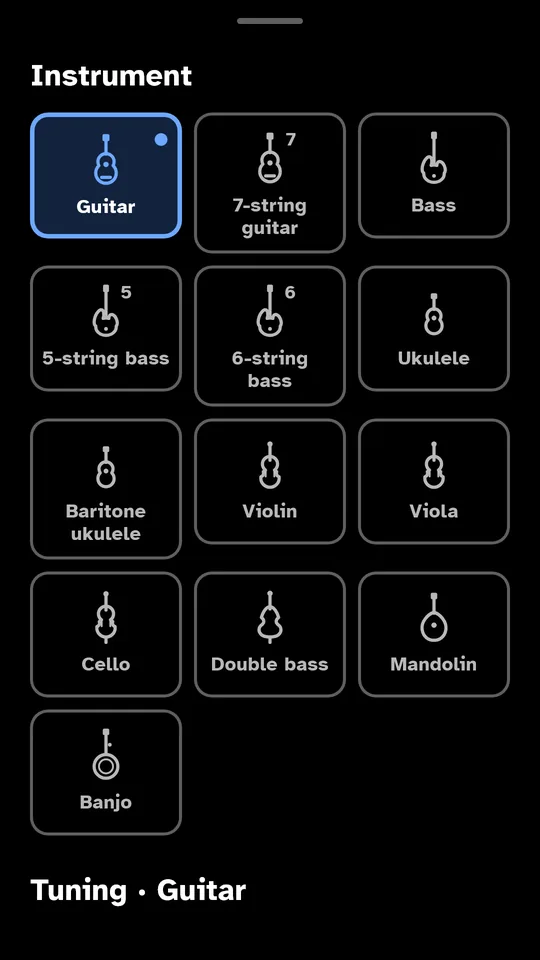
Pick your instrument
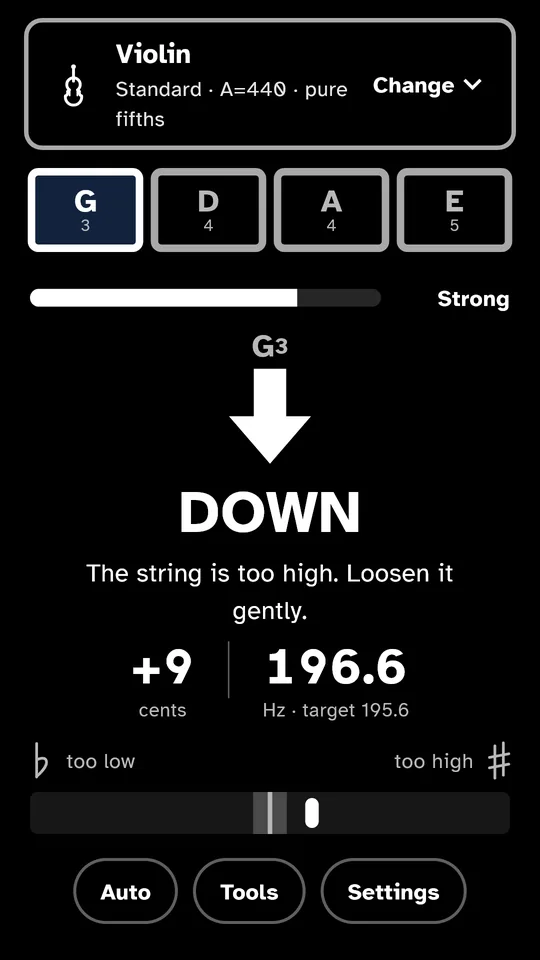
At the top of the screen: the instrument and its tuning.
Play a string
It recognises the string on its own. You can also pick it with a tap.
Follow the word
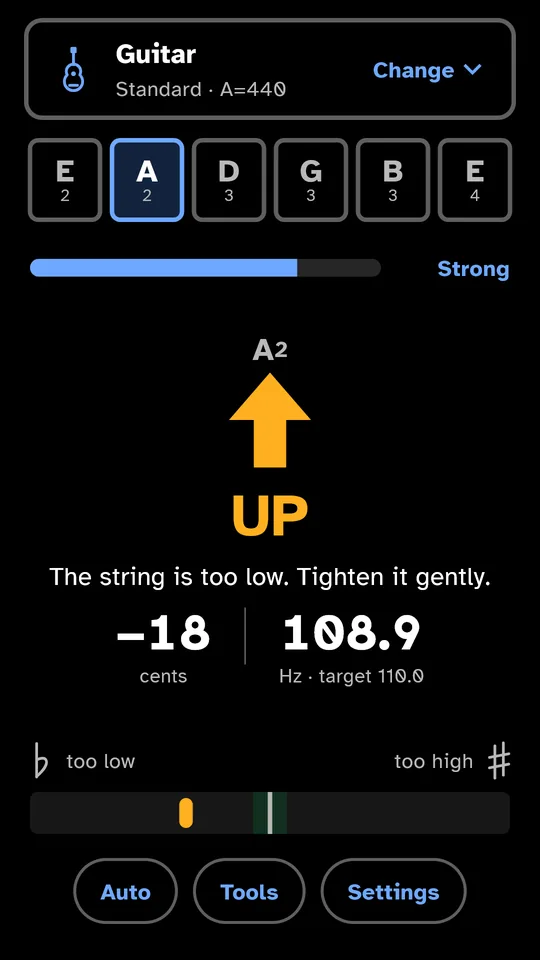
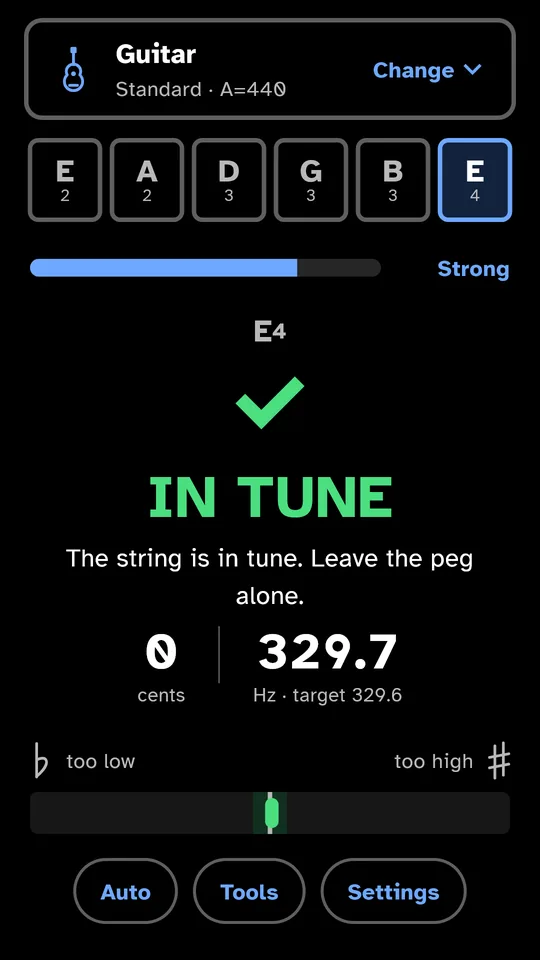
UP or DOWN, until IN TUNE. Then move on to the next string.
Example: the A string is 18 cents too low. The tuner shows UP; the string is tightened up to 110 Hz, and it shows IN TUNE.
You can tune without looking.
Three different vibrations: up, down, and done. They feel nothing alike, so there is nothing to memorise. Put the phone down and keep your eyes on the neck.
UP
grows stronger
DOWN
grows weaker
IN TUNE
two full pulses
It stays quiet when it doesn’t know.
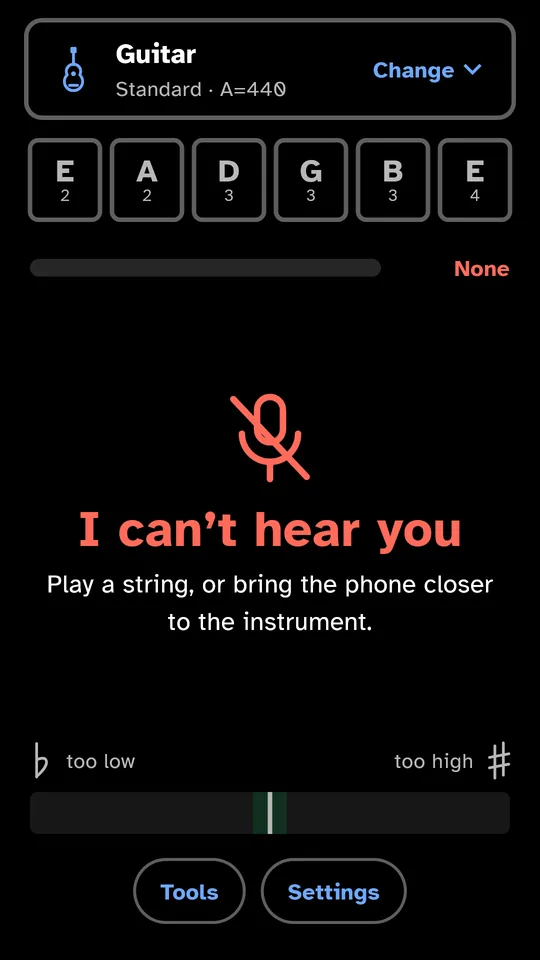
Most tuners show a needle even when they hear nothing usable. Tuner4Strings says “I can’t hear you” or “signal too noisy”, and tells you what to do.
A needle that lies breaks strings.
Instruments
Thirteen string instruments.
From the low B of a 5-string bass to the high E of a violin. Pick yours at the top of the screen, and tune.
- Guitar6 strings
- 7-string guitar7 strings
- Bass4 strings
- 5-string bass5 strings
- 6-string bass6 strings
- Ukulele4 strings
- Baritone ukulele4 strings
- Violin4 strings
- Viola4 strings
- Cello4 strings
- Double bass4 strings
- Mandolin4 string pairs
- Banjo5 strings
- ChromaticEvery note, from the low B to the high E.
- CustomYour own tuning, up to 12 strings.
Tunings
27 tunings. And yours.
Standard, Drop D, DADGAD, Open G, low G on ukulele… If yours isn’t there, create it.
- Reference pitch adjustable from 415 to 445 Hz.
- Take the orchestra’s A, to a tenth of a hertz.
- Violin, viola and cello in pure fifths, as when tuning by ear.
All tunings
Guitar
Standard · A=440
- E2
- A2
- D3
- G3
- B3
- E4
Drop D · A=440
- D2
- A2
- D3
- G3
- B3
- E4
Drop C · A=440
- C2
- G2
- C3
- F3
- A3
- D4
Open G · A=440
- D2
- G2
- D3
- G3
- B3
- D4
Open D · A=440
- D2
- A2
- D3
- F♯3
- A3
- D4
DADGAD · A=440
- D2
- A2
- D3
- G3
- A3
- D4
Half step down · A=440
- E♭2
- A♭2
- D♭3
- G♭3
- B♭3
- E♭4
7-string guitar
Standard · A=440
- B1
- E2
- A2
- D3
- G3
- B3
- E4
Drop A · A=440
- A1
- E2
- A2
- D3
- G3
- B3
- E4
Bass
Standard · A=440
- E1
- A1
- D2
- G2
Drop D · A=440
- D1
- A1
- D2
- G2
Half step down · A=440
- E♭1
- A♭1
- D♭2
- G♭2
5-string bass
Standard · A=440
- B0
- E1
- A1
- D2
- G2
High C · A=440
- E1
- A1
- D2
- G2
- C3
6-string bass
Standard · A=440
- B0
- E1
- A1
- D2
- G2
- C3
Ukulele
Standard · A=440
- G4
- C4
- E4
- A4
Low G · A=440
- G3
- C4
- E4
- A4
D tuning · A=440
- A4
- D4
- F♯4
- B4
Baritone ukulele
Standard · A=440
- D3
- G3
- B3
- E4
Violin
Standard · A=440 · pure fifths
- G3
- D4
- A4
- E5
Viola
Standard · A=440 · pure fifths
- C3
- G3
- D4
- A4
Cello
Standard · A=440 · pure fifths
- C2
- G2
- D3
- A3
Double bass
Orchestral · A=440
- E1
- A1
- D2
- G2
Solo · A=440
- F♯1
- B1
- E2
- A2
Mandolin
Standard · A=440
- G3
- D4
- A4
- E5
Banjo
Open G · A=440
- G4
- D3
- G3
- B3
- D4
Double C · A=440
- G4
- C3
- G3
- C4
- D4
Simplicity
Simple to use. Readable anywhere.
No screen before the tuner.
No welcome screen, no account, no ads. You open it, you play.
The offset is said five ways.
A shape, a word, a sentence, a number, and only last a colour. You don’t need to tell colours apart to tune.
- a shape
- a wordUP
- a sentenceThe string is too low. Tighten it gently.
- a number−18 cents
- a colour
Made to be read from a distance.
High-contrast mode, text up to 200%, announcements for screen readers. The typeface, Atkinson Hyperlegible, was designed for low vision.
Your sound stays on your phone.
Everything is analysed on the device: the sound is never sent anywhere. No account, no tracker, no analytics.
It publishes its figures.
- ± 1 cent
- accuracy over the guitar range (± 2 cents in chromatic mode)
- 25 – 1,400 Hz
- detection range
- < 100 ms
- analysis chain delay
The Workshop
Practice tools, next to the tuner.
Never in front of it: the Workshop opens from the Tools button. A one-time purchase, no subscription, after a 14-day trial.
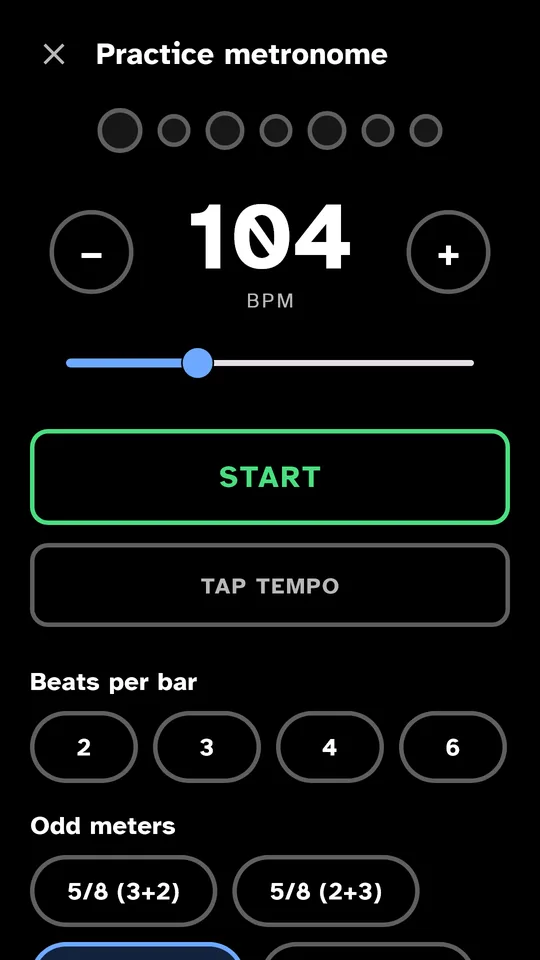
Practice metronome
Subdivisions, 5/8 and 7/8, stepped speed-up, timer.
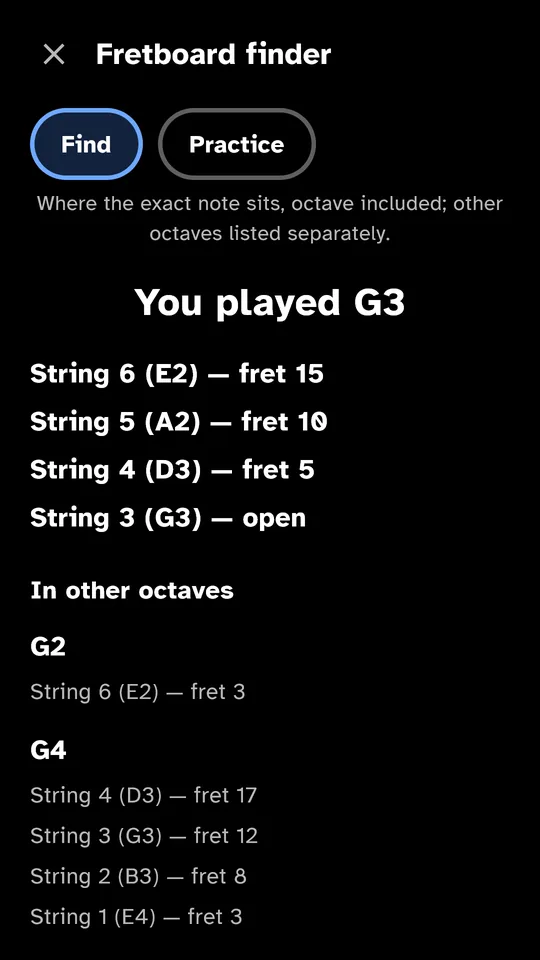
Fretboard finder
The note you play, and every place it lives on the neck.
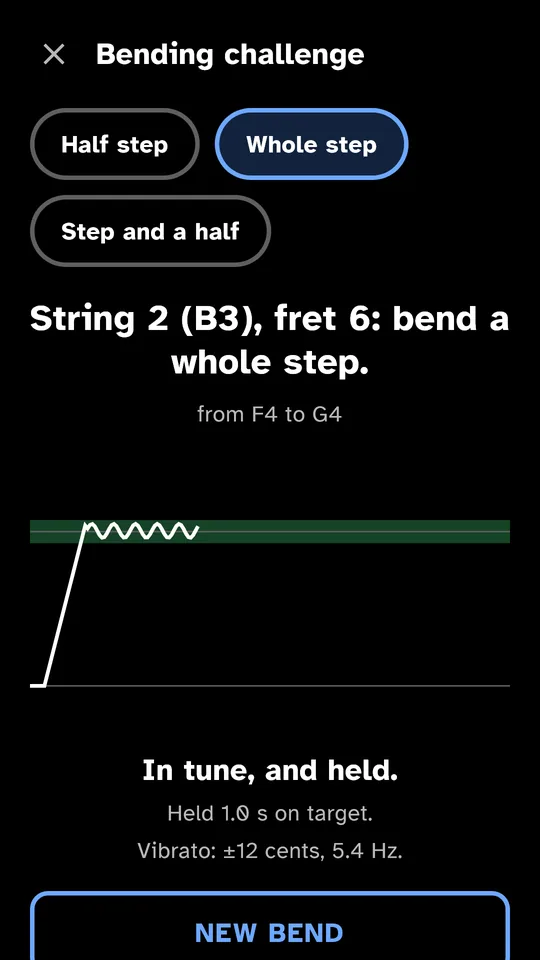
Bending challenge
Bend the string up to the target note, and see the curve.
And also — the drone · sustained note · 12th-fret intonation · the tuning challenge · fine adjustment per string
Tuning itself stays free, forever.
Tune. Then play.
Tuner4Strings is made for one thing: getting you from “I need to tune” to “I’m playing”, without a detour.

Tuner4Strings
Your instrument is waiting.
Coming soon to Google Play and the App Store
Tuning is free, forever.